Showing posts with label Rwanda. Show all posts

Thursday, August 13, 2015

IPRC West School Tour

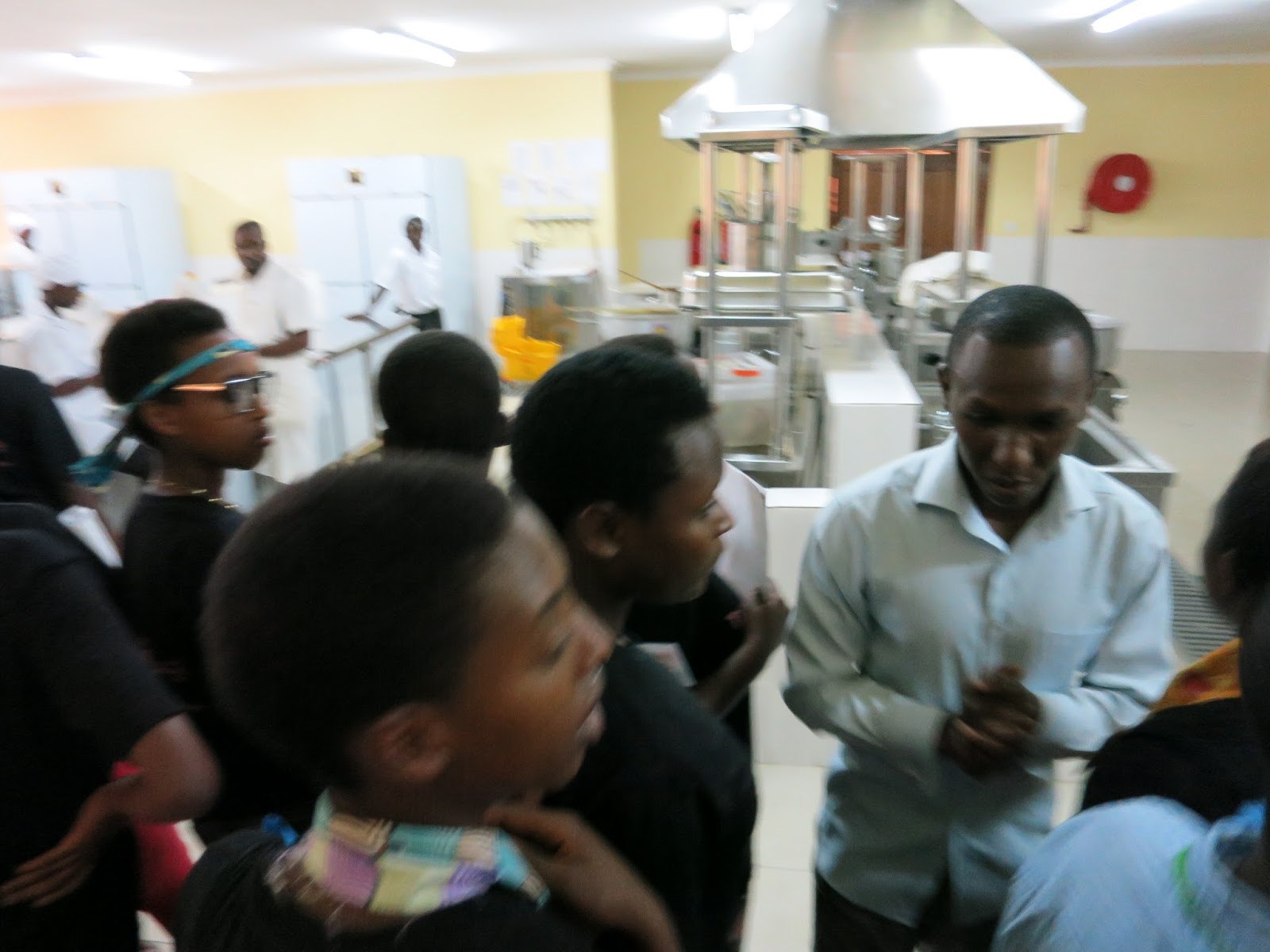
After the Closing Ceremony, IPRC West Principal MUTANGANA Frederic, invited our students on a tour of the schools vocational campus. In addition to the computer labs we had occupied all week, the school has extensive on-site training facilities for mechanics, electronics, and hospitality.

The students were eager to see the spaces they could one day learn in if they continue to study and achieve well in science and technology courses.


Our tour began with a series of labs used for electrical engineering. Many of the ideas about wiring and circuitry that the girls had learned throughout the week were put to use and explained by current IPRC West secondary and vocational students. The best moment came when one of the tour guides clapped his hands and a single lightbulb instantly lit the room. The girls went crazy! They had used Elenco Kits to explore sound activated circuitry but here it was becoming a reality. Needless to say, the rest of the electrical engineer's speech was drowned out by incessant clapping as the lightbulb was repeatedly flashed on and off.

The students visited a metal working studio next on the tour. Heavy machinery used for metal work, carpentry, and welding were explained. The girls were able to view the various items made by IPRC West students, including doors, bed frames, and even a miniature helicopter frame! Another machine was turned on to demonstrate its use in carpentry as it rapidly widdled a block of wood into one of the traditional wooden staffs given at dowry ceremonies around the country.

The coup de grace of the tour was IPRC Wests brand new Hospitality Management Center. Built to teach every aspect of hotel operation, the building looks just like a fancy hotel. The girls pretended to check each other in at the massive front desk and were impressed by the VIP suite with two separate bathrooms. They had a LOT of questions about the industrial-sized laundry room, complete with steamer and a washer that several people could easily fit inside. The stainless steal kitchen was last on the tour - a far cry from the smoke-filled outdoor kitchens used at most Rwandan homes.


The IPRC West tour sparked a great deal of curiosity among the girls. Many of them became determined that they would one day study at IPRC West. The glimpse they had of the technical and vocational facilities not only directly complimented many of our lessons from throughout the week, but it gave the girls realistic school and career options to aspire towards, providing an excellent finale to the TechKobwa program.

Wednesday, August 12, 2015

Written Communication life skills lesson and continuing the Mission Innovation project


The “Mission Innovation” research project continued with students researching their topic on the internet.  Students needed to understand why their topic was important, what solutions had already been tried and why the topic still needed attention, and also to research their ideas to see if someone had already tried their ideas.

The research project is structured such that students receive a lesson or sometimes multiple lessons that build their skills.  They then have another session where they can practically apply those new skills as they complete their research project’s next step.

The internet research session occurred after students learned about the internet and internet safety.  Students also had a Life Skills module on written communication.  This lesson described the importance of a presentation’s objective, the main sections of a presentation, and also discussed the five Ws of Who, What, When, Where, and Why.  We left "how" for another day, given the aggressive time schedule.  Before answering the 5W questions for their research topic, students did an exercise to document their presentation objective and then another of matching various statements with the appropriate “W.”

For example, “because it will increase the food supply” is an example of answering the question “Why?”

Some students were asked to hold signs with one of the five Ws.  Other students took a sample statement and, with the audience’s help, chose the correct W to stand by.  Students enjoyed the activity, though it inspired some questions regarding nuances associated with the English language.


Students received worksheets which they began completing to answer as many of the 5Ws associated with their project as possible.  The questions they could not answer were either questions they could research or decide that the question did not apply in their case.  For example, the “Who” section of their worksheet asked:
  • Who is involved in with your research topic?
  • Who is in your group? Who will your audience be?
  • Who are the experts on your topic?
  • Who is impacted by your topic?
  • Who has tried to help solve the problem?
  • Who might be able to help solve the problem?
Excerpt from the Written Communication Worksheet

Family leaders played a vital role mentoring teams in deciding and documenting their objective as well as in discerning which questions to answer, which ones to research and which ones to skip.  They also played a significant role in helping students, especially students inexperienced in internet usage, in selecting search terms that would quickly yield information.  Finally, they helped students determine if the site they found had credible information or not.

Students also began brainstorming on solutions ideas as they saw what solutions have already been tried or implemented by others.  For most students this was a new experience and family leader mentors were essential to helping the students explore ideas.  This usually best happened if mentors asked students to tell them what they had learned about the topic, what they had learned about solutions, why they chose this topic, what they thought might help, and what role they thought technology could play in helping.

Immediately after conducting their internet research, students began writing their presentation.  This again required heavy involvement by the family leader mentors because students had varying experience levels in summarizing ideas for presentation format versus writing prose in paragraph form.


As student began writing their presentation drafts, they further explored their solution ideas.  By this time in the project, students were very engaged in their topics but also working against a deadline since they needed to present the very next morning.

For some of the teachers, mentoring a team in problem solving techniques was new so the students and ICT teachers both developed skills.  As was the case last year, by the end of the presentation creation session with markers, notes and flip chart pages strewn about, some folks doubted the students would complete in time.  But, I had confidence in them and they did not disappoint.

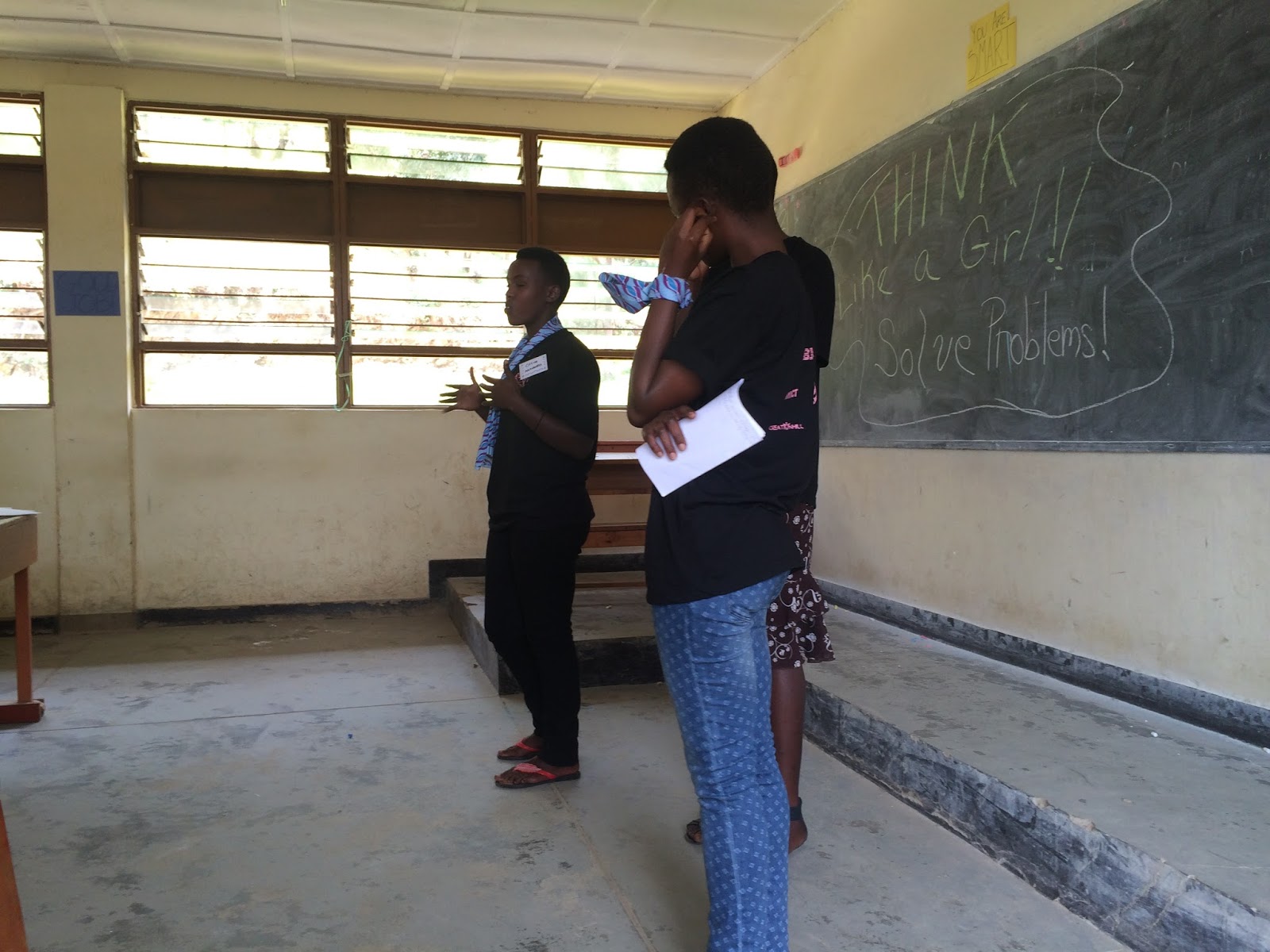
Presenting the Mission Innovation project


Hands-down, my favorite part of Camp TechKobwa is listening to the girls present their research projects.  Both years, throughout the week, I watch a rather rapid metamorphosis take place.  Many girls, who upon arrival barely audibly spoke and when they did it was at their shoes, transform into confident young women discussing major world problems, and more importantly, their ideas for solutions.  I could not be prouder of them.

Every group’s presentation was very good and many were outstanding. 

I wish I could remember all the project ideas but some of their ideas were:

  • Creating an anti-malarial soap and using the internet to advertise it as well as conduct analytical models to improve the formula. 
  • Creating a bio-informatics chip that could detect when someone was bitten by a mosquito, assessing if the mosquito carried malaria and notifying the person and their doctor.
  • Creating a mobile phone app so that a person could touch their finger to the screen and receive almost instantaneous results for a malaria test.  Similarly, a notification could go to their healthcare provider and civil authorities for tracking.
  • Increasing tourism by inserting Rwanda tourism ads when various search word combinations were used.
  • Using sensors and analytics to understand the most critical places to prevent soil erosion and suggest optimal tree and vegetation planting configurations.
  • Using the internet to create a website with planting information and using SMS messages to remind farmers of the most effective techniques for soil erosion prevention, and doing this associated with various cultivation activities.
  • Use analytics to determine the best high yield crops for various parts of Rwanda, identify various planting requirements and share information more expediently between regions by using the internet.
  • Consolidate and improve online booking for hotels and tourist activities.
  • Introduce robots to assist in customer care where there is a shortage of skilled workers.
  • Introduce cameras with analytics to identify key sections of roads requiring improvements.  Provide travel time estimations via a website and mobile application.  Use analytics to determine optimal highway placement and road construction.
  • Create a machine to measure rainfall and trigger an alarm when the rainfall level reaches a critical point for causing soil erosion.  The machine can then begin to work at suggesting anti-soil erosion steps that should be taken.
  • Introduce location based services for promoting tourism to mobile phone users based upon their location within Rwanda, suggesting nearby attractions that might be of interest.
  • Introduce mobile money, online payments and visa card payments for safe money transfer of school fees from parents to the educational institution.
  • Use the internet to build a clearinghouse site for scholarships to help fund school fees.
  • Create a solar-powered radio and mobile phones that can be recharged by water to increase ICT access.
  • Have more camps like TechKobwa to increase access to ICT. (A personal favorite, but "no", I did not plant the idea.) 

Not only did the girls have many great ideas, they enthusiastically expressed them and handled questions with grace and confidence.  Furthermore, many fellow campers asked tough questions – another sign of self-confidence.  Of particular note is the fact that the girls presented, asked questions and fielded questions in English versus their native Kinyarwanda.

I am excited that such confident innovative leaders are emerging to help us tackle some of the world’s grand challenges.

I wish I had pictures of all the groups giving their presentations but here are a few:


Tuesday, August 11, 2015

Learning How Computers Represent Information


The third and fourth CS Unplugged lessons were about representing information.  We gave students abbreviated ASCII tables and they collaboratively decoded a brief text message – the TechKobwa motto “Girls love tech”.  Of course, several of them also took it upon themselves to decode my t-shirt. 


The rest of the third lesson was on representing numbers in binary, following the CS Unplugged curriculum.   I created two ‘flip boards’ as visual aids—one with binary dot-cards affixed to the board and construction paper cards that could be flipped to reveal or hide the card underneath, and the other with 0-cards affixed to the board and 1-cards that could be flipped to make any 5-digit binary number. 


Starting with the former, we gave the students binary “dot cards” and started them off counting up from 0 (all cards face down).  Most caught on very quickly.  A few required some extra help from their family leaders.  All counted from 0 to 31.   


 Then we substituted the dot board for the 0-1 board.  We also found it useful to add a strip showing the powers of 2 beneath the board positions to remind them of the position values.  Students were quickly converting from binary to decimal and back again.  Several volunteered to demonstrate their algorithms for doing so on the board.


The fourth CS Unplugged lesson started with a review and then dove into representation of images.  We passed around copies of the TechKobwa girl at different magnification levels to introduce the concepts of pixels and resolution.  These concepts were all the more real when used to explain why our Skype session from the afternoon before had been blurry. 


I simplified the “Kid Fax” from the CS Unplugged curriculum a bit so we could easily transmit images to Louise.  We first transmitted the resolution and then the run lengths for each row, inclusive of the length of the last run of white pixels, if any.  After walking through our run-length encoding of a simple 5x6 letter “a”, the students decoded the first “Kid Fax” to see the image it created.  Then they transmitted it to Louise, who was sitting with a blank graph paper outside the classroom where she couldn’t see the image, by calling out the series of numbers.  Each time they called a number, they waited for an “ack”.  When done, they were happy to see that she had exactly reconstructed the image from their transmission.


We ran out of time to decode the remaining “Kid Fax” images.  But I noticed many students working them out in their free time, curious to see what image they would find.  We sent the teachers back with materials for expanding this lesson to include representation of color images and creating their own images.

The lesson on image representation was a new one for TechKobwa this year.  Given the enthusiasm, it’s one we’ll want to expand on in future camps.