Showing posts with label IBM. Show all posts

Saturday, August 8, 2015

Preparing the Camp for the Girls and Camper Arrival


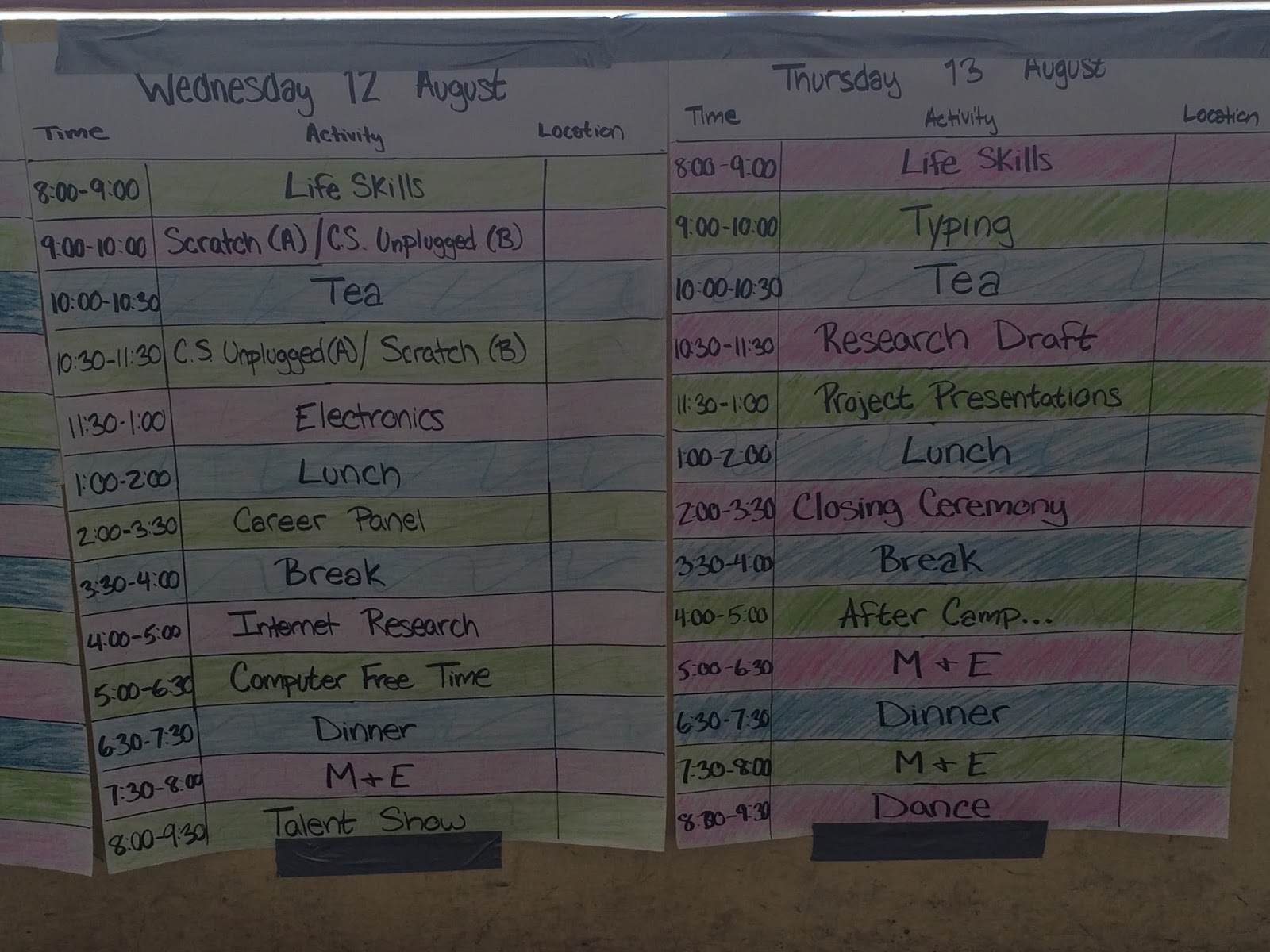
When the Training of Teachers (ToT) concluded, we immediately launched into preparing the camp for the students’ arrival.  Classrooms and the dining hall were decorated, camper schedules were written on large flip-chart paper and hung in the dining hall, and many other activities prepared for the students’ arrival.  All this needed to occur in the span of a few hours.  It helped a lot that Elisabeth held a quick meeting for distribution of duties. 


Bags needed to be prepared for each student containing a notebook, pen, pencil, soap and toilet paper. The list of 60 students was divided into 10 “family” groups containing 6 girls with each coming from a different school.  Two adult “family leaders” were assigned to each group to act as supervisors and mentors.  Each family also was assigned an igitenge with a matching cloth pattern.  Cloth strips were cut and attached to every girls’ bag.  The girls wear these every day, making it easy to identify if a camper is in the wrong place.


Family leaders also prepared colorful nametags and “affirmation bags.”  These bags adorned one wall of the dining hall.  Students, teachers and staff were encouraged to write affirming messages and place them in other’s bags throughout the week.  At the end of the week, campers took their bags home, filled with many affirming statements about their positive characteristics.


This year Michelle Slattery from Peak Research helped us to measure impact.  She needed to organize 6 pre-camp surveys for the girls to take upon arrival.  This was a major undertaking but very valuable to understanding what impacts the camp might have upon girls’ interests and abilities.

Students began arriving on Saturday, August 8th around mid-day.  Upon arrival, they checked-in, submitted their permission slips and insurance cards and surrendered their cellphones for safe-keeping during the camp.  


After check-in and placing their belongings in the dormitory, girls took 6 pre-camp surveys covering topics related to interest in technology, gender perceptions about technology careers and skill-based questions pertaining to each day’s subject material.  

 Since girls travel on public transportation (unaccompanied) across the country to attend camp, girls arrived in multiple waves throughout the afternoon as buses from various parts of Rwanda arrived in the nearby city of Kibuye.  ICT teachers waited at the bus stop in Kibuye to collect girls as they alit from the bus, and then walked the girls the 20 minutes from town to camp. Here are some pictures of Kibuye and the walk between camp and Kibuye.  You see many goats along the way.


By dinnertime, all campers except one had arrived and she arrived early on the following day.

During the first night’s dinner, each family group chose a family name and composed a cheer.  Cheers were done throughout the camp but especially at mealtime.  Even the staff had a team name.  Ours was the “Super Geeks,” as indicated on our table name-tent below.  Our cheer borrowed from the Rick James hit, “SuperFreak” and was a substantially shortened parody of that song with the refrain being “We are Super Geeks, Super Geeks; We’re Super Geeky.”  Maybe we made some new Rick James fans because though the girls were unfamiliar with the original song, they loved our staff cheer.  Some girls would even sing it walking around camp.


Other family names included: Google Team, Apple Team, Peace Family, Shining Stars, Whapthrick, Ada Family, Technology Powers Girls, Super Computers, Vision Quest, and Insta-Browser-Gram.  Here are some of the families introducing their cheer.


We also introduced the TechKobwa cheer to the camp and the girls quickly performed it with great enthusiasm.


Our ToT days were fun-filled with high energy but that did not compare to the energy level once this group of 60 bright upcoming leaders arrived.  We could tell by their family names and cheers that they were a special group of girls.

Training of the Teachers: 2015


A highlight of camp TechKobwa again this year was the 3.5 days in Training of the Teachers (ToT) from August 4 - 7.  With TechKobwa, we hope to interest girls in technology studies and build their self-confidence, but we also want to have farther reaching impact for building capacity.  Therefore each participating school sends six girls but also the ICT teacher.  We hope to create a critical mass within participating schools that will have sustained impact beyond the few girls who come to camp.

The teachers arrive several days earlier than the girls and undergo intense training, learning methods for teaching ICT and self-confidence.  In three days the teachers take all the modules the girls will take during their five day camp in addition to learning other topics applicable espe to ICT teachers, such as how to maintain a computer lab.  The ICT teachers teach many modules to the girls, though they may have only learned the material a few days before teaching the subject.  This gives teachers the opportunity to learn new material and techniques and practice these techniques with a mentor present.

Our training included teachers from 10 schools across Rwanda, 5 mentors from Creation Hill Rwanda, 4 Peace Corps volunteers, 3 people from Michigan State University, a person from Peak Research and one from IBM.  Ice breakers and team-building activities help get such a diverse group comfortable working together as a cohesive team. 
  
 
So, Rusty from the Peace Corps, led the group through several effective exercises, using a rope as the common thread for each.  We jumped rope in teams of two or more. 


We saw how teamwork helped us defy gravity, provided our team member trusted in the support of the other team members.

And, we saw how our collection of talents created a strong network that allowed us to raise others with ease, surprising ourselves at the strength we exhibited as a team.


Blair and Rodney used Elenco’s Snap Circuits kits to teach basic electronic concepts.
 

Laurie taught many Computer Science Unplugged sessions, providing the teachers with material they can teach without needing computers or electricity.  Teachers learned interesting and fun ways to teach binary math, algorithms, and various sort algorithms. 

Here’s an example of an aid which can be used to teach binary math.  Prince and Theogene took turns explaining the topic to the other teachers.


Below the teachers are practicing a human version of a parallel network sort algorithm.  They began the exercise a bit skeptical but felt very surprised and triumphant when they saw the algorithm actually worked.


Teachers also learned programming in Scratch, a visual programming language designed to teach young people basic coding constructs by letting students easily write programs with immediate visual feedback based upon making “sprites” (animated characters) perform various actions.


I reviewed basic internet skills and taught a session on internet safety.  I also introduced the “Mission Innovation” project and familiarized the teachers with their role throughout the week, mentoring the girls on their research projects.  Sorry, there are no pictures but I couldn't act as roving photographer while I taught. (We do have pictures with the girls, however.)

Elisabeth and I also took the teachers through the “Life Skills” modules the students would take.  These modules strive to build skills that raise self-confidence.  We covered topics such as self-confidence, “Finding Your Voice,” written and oral communication, and goal-setting.  Teachers learned the importance of incorporating these topics and also techniques for helping build girls’ self-confidence and problem solving skills.

Elisabeth and KOICA volunteers introduced teachers to a program that teaches them  touch typing.

For teachers with no computers or projection equipment, Elisabeth showed them how they could create mock ups of a keyboard and common applications on rice sacks.  The mock ups allow the teachers to introduce concepts of browsers and the internet.  


Though it made for an extremely packed schedule, the ToT resulted in several teachers either teaching the material to the campers or providing translation from English to Kinyarwanda.